Memory in Latinos

LAMP: Memory and thinking skills in Latinos

What is LAMP?
It is a study that seeks to understand how Spanish-speaking people living in the US perform on cognitive tests (meaning tests of memory and other thinking skills).

You may qualify if:

  • You are between 60 and 85 years old
  • You are Hispanic or Latino/a
  • Speak Spanish

  • Results of your memory tests at no cost to you.
  • Flexible hours to schedule study visits.
  • You will receive payment for your time.
  • Assistance available for transportation to study visits.
  • All information is confidential and voluntary.

Let's make a difference in the community

Duke Health Logo

Fill out the Studies Interest Form for more information.

A close-up of a smiling senior couple. The man and woman are wearing light blue shirts and are seated. The woman is in front of the man, and the man's hands are embracing her shoulders. Out-of-focus bushes are visible in the background.

Memory and Aging Study

What is normal memory loss as we get older?
The Memory and Aging Study will identify the biological factors involved in normal brain aging and disease. We need a group of people of different backgrounds to participate in this important research which we hope will have a positive impact in your community.

You may participate if you are:

  • Between ages 25 and 44
  • Willing to attend annual study visits and participate in any or all study procedures:
    • Brain imaging (MRI)
    • Memory evaluations
    • Blood tests
    • Spinal fluid sample

You will be paid for your participation.


In collaboration with:In collaboration with Duke Health, UNC School of Medicine, National Institute on Aging Designated Alzheimer's Disease Research Center


Fill out the Studies Interest Form for more information.

Portrait Of Multi-Generation Family Group On Winter Beach Vacation

Deep Sleep Is Crucial for Brain Health

A new UC Berkeley study suggests that changes in deep (non-REM) sleep may be linked to episodic memory loss and to Alzheimer’s-related changes in the brain. Researchers measured brain waves during sleep using electroencephalography (EEG). They compared the brain waves of people in their early 20s with those in their mid-60s to mid-70s. They found that, compared to young adults, older adults without dementia showed disrupted brain wave patterns that were associated with poorer memory and more tau- an Alzheimer’s disease protein- in the brain. Several years later, the older adults with continued buildup of tau in their brains had greater disruption of brain waves and poorer memory.

It is still unclear which begins first: the disruption of the brain waves or the accumulation of tau in the brain. However, these findings highlight both the complexity of the role of sleep in the development of Alzheimer’s disease and the importance of sleep in maintaining brain health.

To learn more, visit this link.

Oct eblast_deep sleep for brain health

Eyes and Memory Study

Non-Invasive Study to Assess Retinal Blood Vessels in the Eyes (iMIND)

We are recruiting cognitively normal adults over 18 years old for a study to take non-invasive pictures of the retina of the eyes.

About the Study

  • Noninvasive pictures will be taken of the retina of the eyes.
  • No x-rays, no eye drops, no eye contact are involved.
  • The study visit takes 30-45 minutes.
  • There will be no charge to you or your insurance.
  • Participants will be compensated.

Who Is Eligible?

  • Cognitively normal
  • 18 years or older

Who Is Not Eligible?

  • Have had prior retina surgery
  • Are not willing to have undilated pictures taken of their eyes
  • Have any of the following:
    • Alzheimer’s disease
    • Dementia
    • Down syndrome
    • Frontotemporal dementia
    • Lewy body dementia
    • Mild cognitive impairment
    • Multiple sclerosis
    • Parkinson’s disease
    • PTSD
    • Traumatic brain injury
    • Other neurodegenerative condition

Duke Health Logo

Fill out the Studies Interest Form for more information.

Dementia in African American Families

Genetic Studies in Familial Dementia (African Americans)

Alzheimer's. It runs in our families.

Alzheimer's affects African Americans twice more than other races and there is no cure. Scientists are conducting research on Alzheimer's Disease and we need your help! We are seeking families where two or more family members are affected with memory loss or dementia to join this research study. Participants are not required to travel and they receive monetary compensation. Contact us today if you are interested in making Alzheimer's a memory.


Wake Forest University School of Medicine Logo

Fill out the Studies Interest Form for more information.

MACHE postcard - One side_SIDE B dec2025

Cholesterol Medication and Memory Study

Pragmatic Evaluation of Events and Benefits of Lipid-lowering in Older Adults (PREVENTABLE)

Could taking a commonly used heart medication prevent dementia?

What is the PREVENTABLE study?
PREVENTABLE is one of the largest studies in older adults. The goal is to learn if taking a statin could help older adults live well for longer by preventing dementia, disability, or heart disease. This is a study about preventing memory loss and dementia – something we all care about.

You may be a good fit for the study if you:

  • Are 75 years or older
  • Are not taking a statin
  • Do not have heart disease (heart attack or stroke)
  • Do not have dementia

Taking part in PREVENTABLE is easy.
Participants can join the study at home by phone or videoconference, get study drug by mail, and be followed by phone, health records or home visits, if necessary.

“This is not just a statin study – it is a study about cognitive health”

By participating, you will leave a legacy by advancing science for healthy brain aging helping generations to come!


Duke Health LogoWake Forest University School of Medicine Logo

Fill out the Studies Interest Form for more information.
preventable

Black American United Memory & Aging Project

Black American United Memory & Aging Project

This study was developed to identify social, cultural, behavioral, environmental, and biological factors that may affect our memory as we age and put some people at a greater risk for memory loss.

Did you know that Alzheimer’s disease is the 4th leading cause of death among older Black Americans?

This is particularly alarming given that Black Americans:

  • Are two times more likely to develop late-onset Alzheimer’s disease.
  • Are diagnosed in the later stages of the disease.
  • They present with greater memory impairment when they see a doctor and are diagnosed at later disease stages compared to whites.

What the study will learn from this project will help researchers in the future better understand how to treat the disease and, hopefully, one day, how to cure it.

You may be eligible to participate in this study if you:

  • Identify as a Non-Hispanic Black American
  • Are age 55 and older
  • Have not been diagnosed with Alzheimer's disease or any type of dementia

Participants will be compensated.


Fill out the Studies Interest Form for more information.
flyer

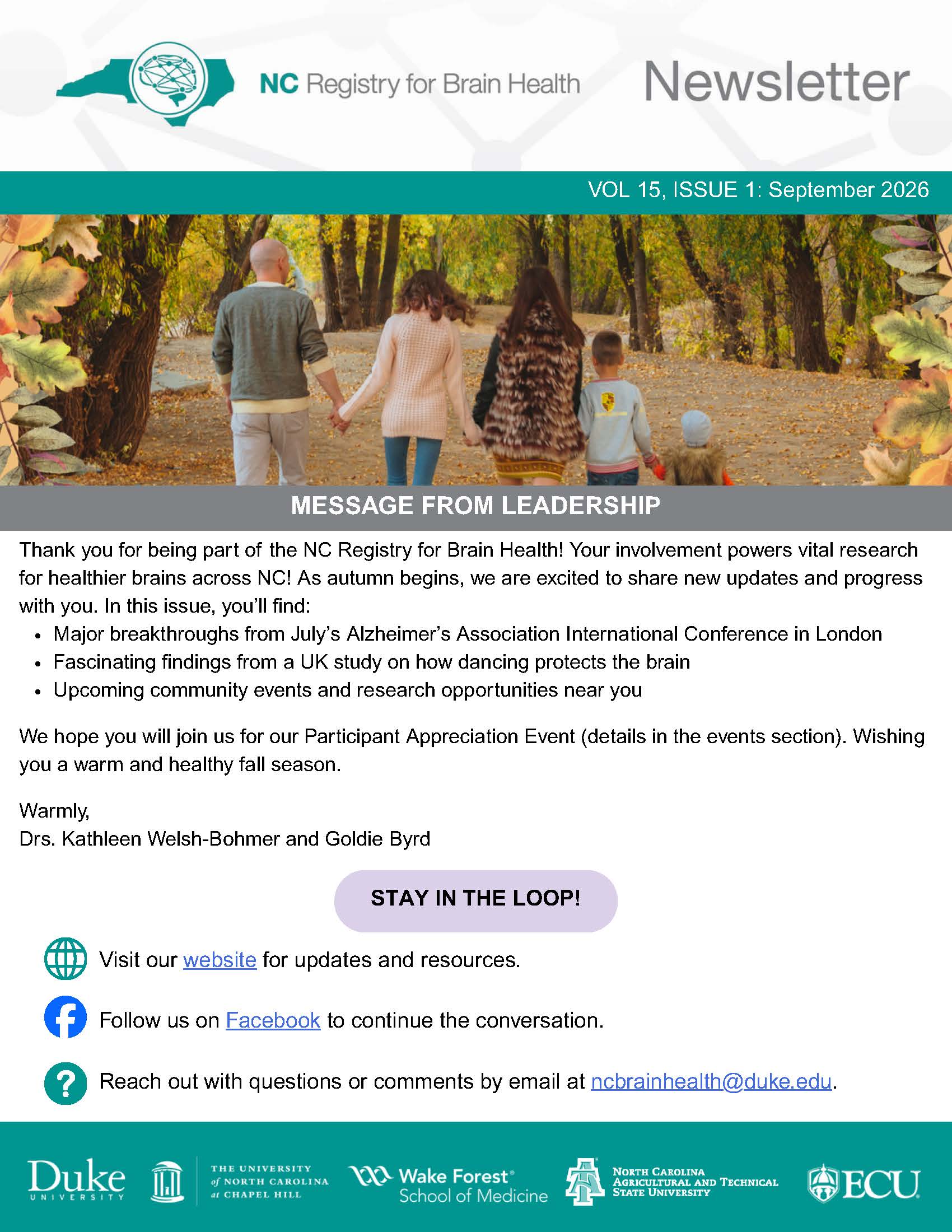
Fall 2026 Newsletter

Our fall newsletter includes updates from this year’s Alzheimer's Association International Conference, highlights research on dancing and brain health, and features upcoming community events and research opportunities.

Click here to view the full newsletter and join us on Facebook.

Recovering Brain Health After a Stroke

The incredible ability to adapt and recover after a stroke shows how resilient the brain is to injury. Neuroplasticity, or the brain's ability to create new connections and reorganize itself, plays a crucial role in recovering from a stroke. Some people experience extraordinary gains, especially during the first few months after a stroke when the brain may be especially responsive to therapy. But it is important to note that recovery can continue over time and may be helped by targeted rehabilitation, repeated practice, movement, healthy sleep, stress management, social connection, and overall brain-healthy habits. These are the same behaviors that help maintain brain health in individuals who have not had a stroke.

The acronym ‘BE FAST’ can help you recognize the signs of a stroke in yourself or a loved one:

  • Balance (loss of coordination)
  • Eyes (changes in vision)
  • Face (drooping features on one side)
  • Arms (weakness in a limb)
  • Speech (difficulty speaking)
  • Time (call 911 immediately)

To learn more, visit this link. For a more technical article on therapies after a stroke, visit this link.

August eblast_Recovering brain health after a stroke

Are Dementia Rates Really Dropping?

This month, we wanted to share an Economist article highlighting a hopeful shift in the fight against dementia. While dementia remains a major global health challenge, recent research indicates declining new diagnoses among older adults in some countries. This is likely due to better education, improvements in cardiovascular health, and reduced smoking. At the same time, advances in earlier detection, blood-based biomarkers, and new treatments are changing how dementia may be identified and managed. As NC Registry for Brain Health participants, the key message is that adopting healthy daily habits can help reduce your risk of dementia as you age. Staying physically active, managing blood pressure, diabetes, and cholesterol, remaining socially and mentally engaged, treating hearing or vision problems, eating well, and participating in research can all support healthier aging and get us closer to better prevention.

To listen to the full article, visit this link.

August eblast_Are dementia rates really dropping