Deep Sleep Is Crucial for Brain Health

A new UC Berkeley study suggests that changes in deep (non-REM) sleep may be linked to episodic memory loss and to Alzheimer’s-related changes in the brain. Researchers measured brain waves during sleep using electroencephalography (EEG). They compared the brain waves of people in their early 20s with those in their mid-60s to mid-70s. They found that, compared to young adults, older adults without dementia showed disrupted brain wave patterns that were associated with poorer memory and more tau- an Alzheimer’s disease protein- in the brain. Several years later, the older adults with continued buildup of tau in their brains had greater disruption of brain waves and poorer memory.

It is still unclear which begins first: the disruption of the brain waves or the accumulation of tau in the brain. However, these findings highlight both the complexity of the role of sleep in the development of Alzheimer’s disease and the importance of sleep in maintaining brain health.

To learn more, visit this link.
Oct eblast_deep sleep for brain health

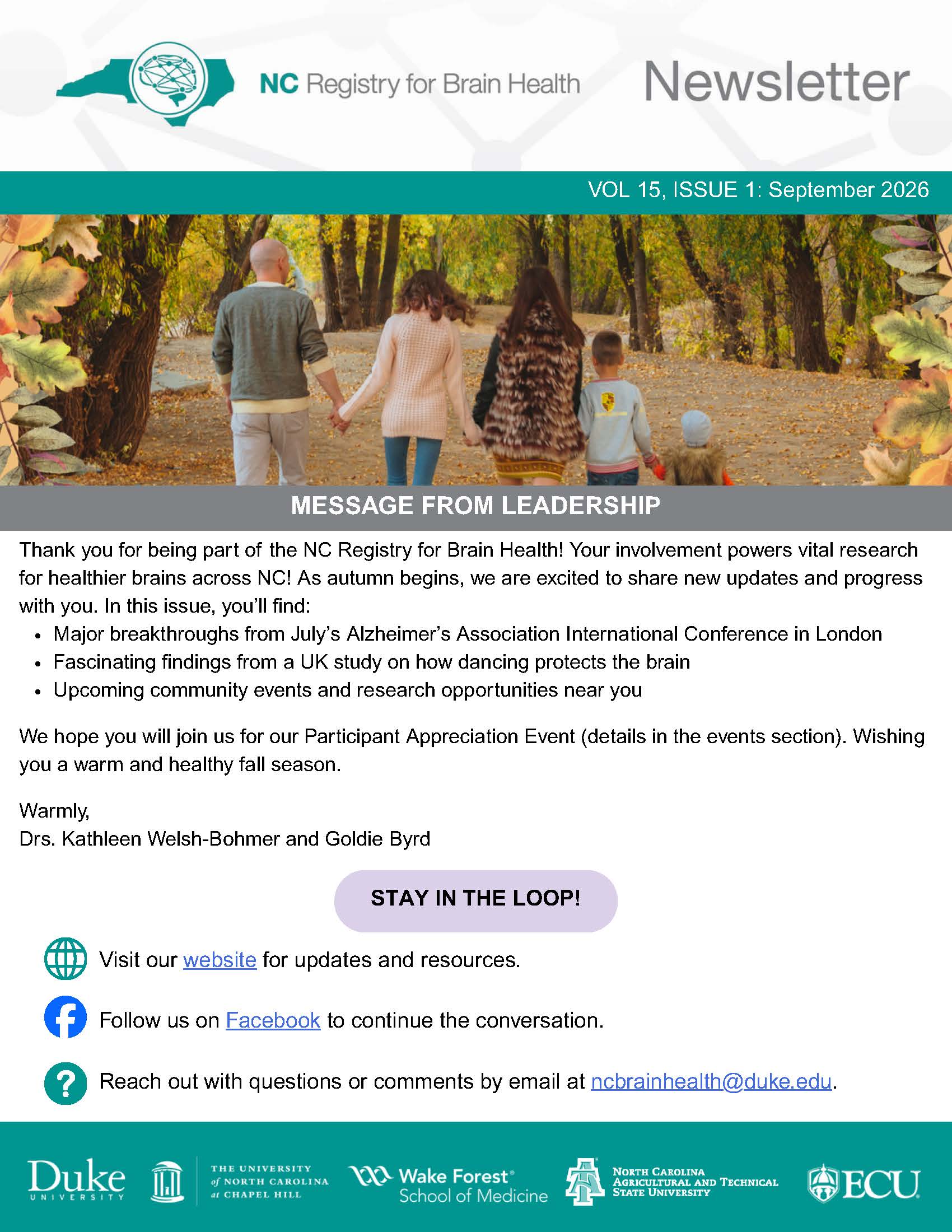
Fall 2026 Newsletter

Our fall newsletter includes updates from this year’s Alzheimer's Association International Conference, highlights research on dancing and brain health, and features upcoming community events and research opportunities.

Click here to view the full newsletter and join us on Facebook.

Recovering Brain Health After a Stroke

The incredible ability to adapt and recover after a stroke shows how resilient the brain is to injury. Neuroplasticity, or the brain's ability to create new connections and reorganize itself, plays a crucial role in recovering from a stroke. Some people experience extraordinary gains, especially during the first few months after a stroke when the brain may be especially responsive to therapy. But it is important to note that recovery can continue over time and may be helped by targeted rehabilitation, repeated practice, movement, healthy sleep, stress management, social connection, and overall brain-healthy habits. These are the same behaviors that help maintain brain health in individuals who have not had a stroke.

The acronym ‘BE FAST’ can help you recognize the signs of a stroke in yourself or a loved one:

  • Balance (loss of coordination)
  • Eyes (changes in vision)
  • Face (drooping features on one side)
  • Arms (weakness in a limb)
  • Speech (difficulty speaking)
  • Time (call 911 immediately)

To learn more, visit this link. For a more technical article on therapies after a stroke, visit this link.

August eblast_Recovering brain health after a stroke

Are Dementia Rates Really Dropping?

This month, we wanted to share an Economist article highlighting a hopeful shift in the fight against dementia. While dementia remains a major global health challenge, recent research indicates declining new diagnoses among older adults in some countries. This is likely due to better education, improvements in cardiovascular health, and reduced smoking. At the same time, advances in earlier detection, blood-based biomarkers, and new treatments are changing how dementia may be identified and managed. As NC Registry for Brain Health participants, the key message is that adopting healthy daily habits can help reduce your risk of dementia as you age. Staying physically active, managing blood pressure, diabetes, and cholesterol, remaining socially and mentally engaged, treating hearing or vision problems, eating well, and participating in research can all support healthier aging and get us closer to better prevention.

To listen to the full article, visit this link.

August eblast_Are dementia rates really dropping

No Age Limits to Improved Brain Health

A new study shares some uplifting news: it is never too late to boost your brain health. A three-year study of 4,000 adults found that simple brain health activities can improve thinking and memory skills even into their 80s. Participants who stayed mentally active, socially connected, and emotionally supported experienced sharper thinking and a stronger sense of purpose. These findings remind us that consistent, small actions make a difference throughout life.

To learn more about the brain health index, visit this link.

July Eblast_No Age Limits to Improved Brain Health

Celebrating the Power of Aging

This July, as our country prepares to celebrate its 250th anniversary, we honor the generations of older adults who helped shape America’s history, communities, and future. AARP highlights inspiring Americans who made meaningful contributions later in life, reminding us that aging is a time of wisdom, purpose, creativity, and continued impact. At the NC Registry for Brain Health, we celebrate the important role older adults play in building healthier communities and advancing brain health for generations to come.

To learn more, visit this link.
July Eblast_Celebrating the Power of Aging

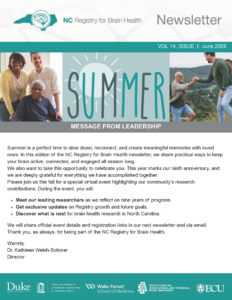
Summer 2026 Newsletter

The summer edition of the NC Registry for Brain Health newsletter highlights ways to keep your brain active and engaged all season through research opportunities, community events, and daily habits.

We're also celebrating our ninth anniversary and your contributions to the NC Registry for Brain Health. Thank you for being part of our community and for everything we have accomplished together!

Click here to view the full newsletter and join us on Facebook.

New Study Links High-Dose Flu Vaccine to Lower Alzheimer’s Disease Risk

A recent study suggests that getting your yearly flu shot, especially at a higher dose, may help protect your brain health as you age. Researchers studied data from nearly 200,000 adults aged 65 and older and found that those who received a high-dose flu vaccine were less likely to develop Alzheimer’s disease compared to those who received the standard dose. While the regular flu shot lowered Alzheimer’s risk by about 40%, the high-dose version was linked to an even greater reduction (nearly 55%). 

These findings show the strong connection between overall immune health and brain health. As we get older, our immune system naturally weakens, and high-dose vaccines are designed to provide additional protection. Experts say that staying up to date on vaccines may do more than prevent illness; it could also be a simple way to support long-term brain health. 

To read more, visit this link. 

May eblast_high dose flu vaccine

Turn Up the Volume on Brain Health: How Hearing Aids May Ease Dementia Symptoms

We’ve highlighted in the past how important hearing is in keeping your brain healthy. Research shows that hearing loss is quite common among older adults, affecting up to 80%–90% of the population. It can also lead to social isolation, stress, and a lower quality of life. Recent studies have strengthened this connection, especially for people living with dementia. In a large study looking at data from over 10,000 participants from the National Alzheimer's Coordinating Center, researchers found that those with dementia who used hearing aids tended to experience fewer symptoms like depression, anxiety, and agitation. Though, hearing loss on its own wasn’t always linked to more severe behavioral and mood symptoms. This study highlights that addressing hearing loss can be a practical, easy way to improve the well-being of people with dementia.  

To learn more, visit this link.

May eblast_Turn up the volume on brain health (1)

Advancing Brain Health in North Carolina: A Conversation with Dr. Kathleen Welsh-Bohmer

In an interview with the North Carolina Medical Journal, NC Registry for Brain Health's Dr. Kathleen Welsh-Bohmer discusses the development of the NC Registry for Brain Health and shares how her scientific background led to her interests in brain health education and research literacy.

You can read the condensed interview at this link. To listen to the full interview, visit this link.